
By Timothy Albrite
Why a WRC Car may have Nothing in Common with Your Showroom Model.
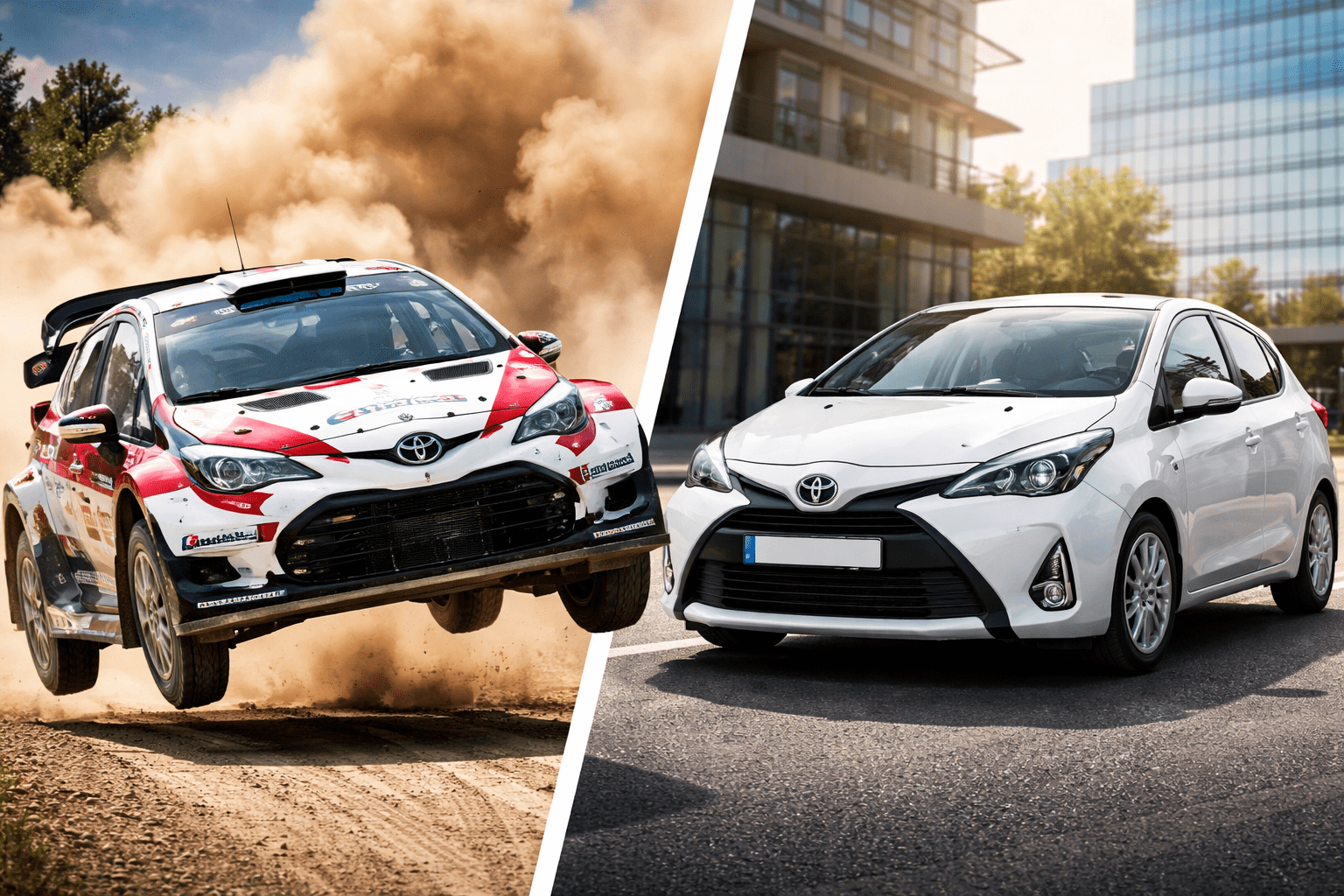
If you’ve stood by the side of a rally stage in Naivasha, you’ve heard that machine-gun sound—pop-pop-bang—as a car flies past. On the outside, that Toyota GR Yaris or Hyundai i20 looks a lot like the one in a Nairobi showroom. But pop the hood, and you’ll realize the only thing they truly share is the badge and the headlights.
Last week, Takamoto Katsuta made history by winning the 2026 WRC Safari Rally. His car costs upwards of KSh 100 million. For that price, you could buy a whole fleet of luxury SUVs. So, why the massive price tag? Here is the “surgical” difference between your daily driver and a Safari beast.
1. The Skeleton: Comfort vs. Survival
Your car is built for what engineers call “NVH”—Noise, Vibration, and Harshness. It is designed to be quiet and soak up bumps on the way to the office.
A rally car is different. Engineers take a standard body shell, strip it to the bare metal, and throw away everything, the seats, the carpets, even the dashboard. They spend weeks adding thousands of extra “seam welds” to make the metal stiff. Finally, they weld in a T45 steel roll cage. This isn’t just for safety; it’s a “survival cell.” If a rally car rolls ten times down a
hill at Kedong, the driver usually walks out. In your normal car, the roof would likely flatten to the steering wheel.
2. The Suspension: Potholes vs. 30-Meter Jumps
Think about the last time you hit a bad pothole. You probably winced and hoped your rim wasn’t bent.
Now, imagine hitting that same pothole at 140km/h—while jumping. A WRC car uses dampers that cost more than a used Toyota Vitz. These shocks have about 300mm of “travel.” They are designed to absorb a massive leap and immediately settle the car so the driver can steer. In your normal car, the suspension would simply “bottom out,” snapping your axle and sending your teeth through your lip.
3. The “Anti-Lag”: Why It Pops and Bangs
That machine-gun sound when the driver lets off the gas is the Anti-Lag System (ALS).
In your car, when you lift your foot, the turbocharger slows down. When you step on it again, there is a delay—”turbo lag”—before the power kicks in. In a rally car, that delay is a death sentence for a fast stage time. The ALS keeps fuel and air moving through the engine and exploding inside the exhaust manifold even when the throttle is closed. This keeps the turbo spinning at max speed so the power is instant when the driver goots it again.
Pro-tip: Don’t try this at home. A rally exhaust is made of exotic materials to handle that extreme heat. If you tried to map “pops and bangs” onto your standard 1.5L engine, you would melt your valves and blow your catalytic converter.
4. The Cockpit: No Radio, No AC
Inside your car, you want a touchscreen and cold AC. Inside a WRC car, it’s a furnace. Even with roof vents, it can hit 50°C inside during a hot Naivasha afternoon.
There is no “Park” or “Drive” here. You have a massive vertical handbrake for instant rear-wheel lock-ups and a sequential gear shifter. The seats are “buckets” molded to the driver’s body, and the “dashboard” is just a tiny digital screen that tells you the essentials: gear, RPM, and temperature.
Your normal car is a masterpiece of comfort. A rally car is a weapon of war. One is built to get you home; the other is built to survive the impossible.