
By Timothy A Ongaya
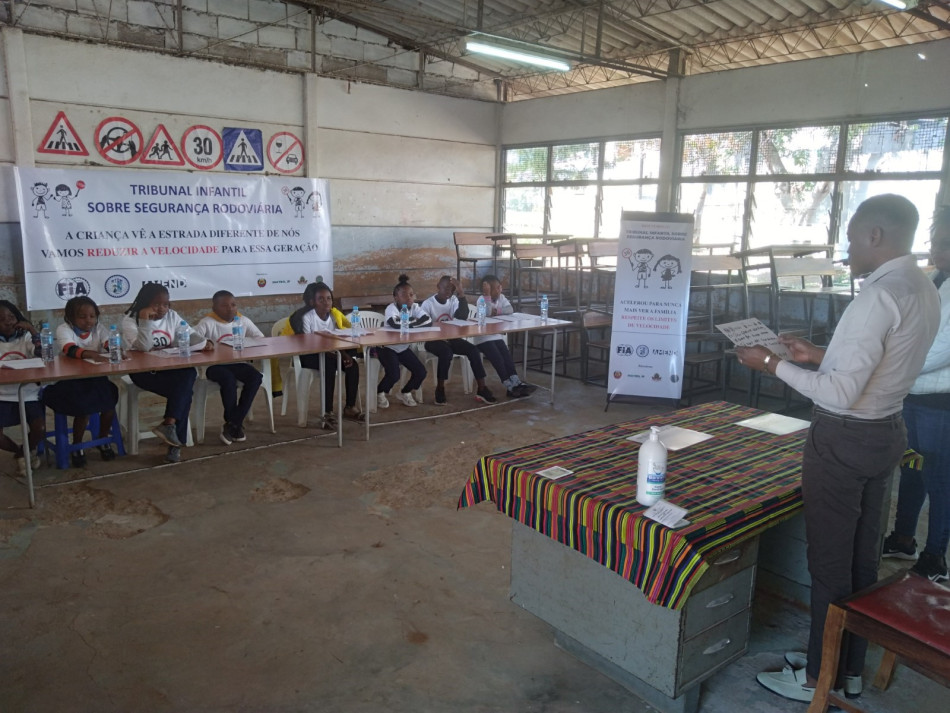
Imagine being summoned to a courtroom not as a lawyer, not as a witness, but as a driver who’s been caught speeding. And then comes the surprise: the judges staring back at you are children. They’re the ones deciding your fate. Sounds unreal, right? Yet this is exactly what happens in Mozambique’s “Kid’s Court,” an eye-opening initiative changing the way communities understand and teach road safety.
Mozambique has one of the highest road fatality rates in Africa. According to the World Health Organization, the country loses about 30.1 people per 100,000 each year to road crashes. In Maputo, the capital, the problem is even more urgent. Chaotic traffic, poor pedestrian infrastructure, and drivers who often ignore basic road rules all add up to a dangerous environment especially for children who have to walk to school daily.
That’s where the “Return to Safer Schools” initiative comes in. Led by the Automóvel e Touring Clube de Moçambique (ATCM) in partnership with the road safety NGO Amend, the project focuses on improving safety around five schools. Their goal is simple but vital: protect children on their way to and from school.
It all began with a tough reality check. Kids in Maputo were risking their lives just getting to class. Sidewalks were unsafe or nonexistent, traffic was unpredictable, and many drivers weren’t slowing down anywhere near schools. Using a road-safety assessment toolkit from the International Road Assessment Programme (iRAP), ATCM mapped out the problem areas around each school.
What they found was alarming. School zones lacked clear signs, traffic moved too fast, and crossing the road was often a gamble. So ATCM rolled up its sleeves. They installed 24 new road signs, painted five zebra crossings, and introduced designated “Safe School Zones” where cars must slow down to 30 km/h. These changes alone made the area around schools much safer for children.
But the heart of the program, the part that really caught the world’s attention, is the “Kid’s Court.”
When a driver is caught speeding or breaking traffic rules near a school, they don’t simply get a ticket. Instead, they’re brought before a panel of children who act as judges. These kids ask honest, straightforward questions: Why were you speeding? Do you realize you could have hurt someone? It’s a moment that forces drivers to come face-to-face with the very children whose lives they’ve put at risk.
And rather than paying a fine, drivers sign a pledge promising to drive more responsibly around school zones. Many of these sessions are broadcast on radio and TV, turning each case into a powerful lesson for the entire community.
The “Kid’s Court” isn’t just a teaching tool, it’s empowerment. Children get a chance to confront real issues, speak up about their safety, and be part of the solution. They become road-safety champions, using their voices to bring about real change.
So, what can Kenya learn from this? And what would it look like if our own school zones had their version of a Kid’s Court?
It’s a question worth thinking about.